
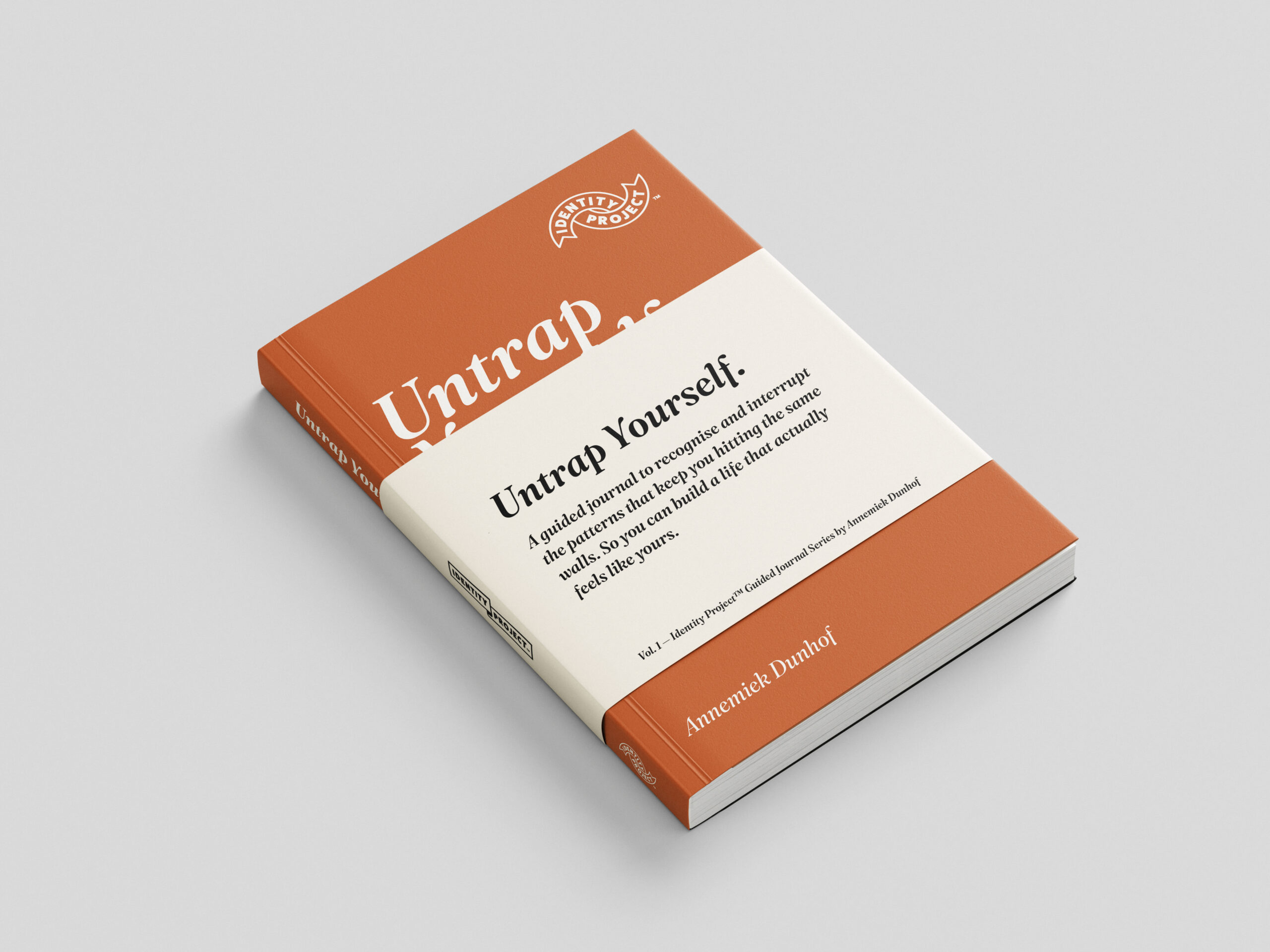
Untrap Yourself is a guided journal for breaking patterns and building a life that feels like yours. Created for overthinkers, perfectionists, and people-pleasers who are tired of hitting the same walls but can’t quite name what’s keeping them stuck. Through a blend of psychology, psychoeducation, and self-reflection, you’ll uncover the patterns running beneath your behaviours, understand where they came from, what they protect, what they cost you, and how to interrupt them in real time. So you can stop living by pressure, shoulds, and expectations, make decisions that feel true to you, and create a life that genuinely feels like yours.
Here’s the story behind the Untrap Yourself Journal Guided Journal.
Why I Created the Untrap Yourself Journal
This can’t be it. That blunt realisation started Untrap Yourself, the first guided journal in the Identity Project Guided Journal Series.
From the outside, everything looked as it should. I had built a successful business, worked with clients around the world, and achieved many of the things I thought would make me feel fulfilled.
Inside, I was exhausted. I detested the way I built my business. And could no longer ignore it. It didn’t feel like me. It burned me to the ground. But I couldn’t see a way out.
So at first, I persisted. I kept trying to make it work. One more push would make it all worth it again. It’s just a phase, I told myself. Every day. Assuming the solution was to try harder.
I bargained myself into different versions. Tried new approaches. Healthier routines. More sleep. More mindset work. Extra time off. A deeper dive into personal development. More therapy. And a growing collection of distractions that kept me from asking the real question: Why do I keep hitting the same walls?
How I Discovered the Pattern Behind My Burnout
‘Holy shit, I’ve been doing this my whole life. It just looked different every time.’
Burnout wasn’t the first time I realised it. It started with running. Which turned into watching what I ate. Obsessing over my weight and the number on the scale. Discipline had turned into extreme control. Restriction into anorexia. When I got better, it shifted to a rigid routine: detoxing, juice cleanses, fasting, yoga, meditation. It looked healthy. But if I missed one practice, I’d be at my wits’ end. No spontaneity. No nights out. Isolation felt like the only way I could stay in control. Then it moved into work. Into my business. Determined to make it a huge success. Twelve-hour workdays and relentless pushing. All to prove I was worth something. Not just to clients. To myself.
Burnout wasn’t exhaustion alone. It was the moment the pattern finally ran out of road. It forced me to stop. And stopping — truly stopping — was the first time I could see the pattern. Three different life phases. Three different obsessions. With the same behaviour running through all of it. Discipline and control, pushing me until I broke. With one belief underneath: to be valuable, I need to deliver outstanding results.
Every time I got better, it relocated and found a new context. And started running the same story somewhere else. Because that’s what patterns do.
Patterns don’t stay where you uncover them. They only change when you interrupt their logic.
Why Patterns Are So Hard to Change
One of the most frustrating things about breaking patterns is that patterns rarely disappear when you identify them. Seeing them doesn’t automatically stop them. Instead, they relocate. You stop over-controlling food and start over-controlling work. You stop people-pleasing in relationships and start people-pleasing clients. You leave a job that drains you only to recreate the same pressure somewhere else.
The behaviour changes. The logic beneath the pattern doesn’t.
That’s because behaviours are only the visible part of the pattern. Beneath them sit assumptions you made years ago. Beliefs about who you need to be and how you need to behave to keep your place. Survival strategies that helped you belong, avoid rejection, stay safe, gain approval, or make sense of difficult situations. Those strategies were adaptive, created by a younger version of you. The problem is that many of them were carried forward long after they stopped serving you. And if that underlying logic remains untouched, the pattern simply finds a new place to operate.
How Journaling Helped Me Understand My Patterns
Journaling helped me make sense of why I felt off. That sense of being stuck, disoriented, and lost. It helped me see the pressure I had normalised. The internal rules I was following. Stories I believed, but weren’t facts. Even the behaviours that looked productive on the surface were keeping my patterns intact.
Journaling itself didn’t solve these problems. It helped me see them clearly enough to make different decisions. What I needed to shift. Who I could be without those self-imposed shoulds. It helped me step out of boxes and labels, pressure and expectations. And make the most frightening decisions. Decisions that cracked my life wide open and initiated changes I could have never prepared for.
I ended a relationship with a man I thought I would marry. Moved out of the country I lost my heart to. Closed a business I thought would be my life’s work. Walked away from Annie, the version of me that was independent and unstoppable, but felt absolutely nothing. And finally, reclaim my birth name and become Annemiek. I started over without a plan. Without knowing how. Without a clue of what came next. With a thirty-thousand euro debt and no way to pay my mortgage. But a desperate need to find out who I actually was. Because that extreme exhaustion wasn’t normal. It wasn’t a sacrifice necessary to succeed. It was a big fat sign this couldn’t be it. I needed to drastically change my ways.
How the Untrap Yourself Journal Was Created
The exercises inside Untrap Yourself started as my own messy mind dumps. Questions I asked myself, answered on pages filled with unfiltered brain farts, slowly revealing the traps I couldn’t unsee. Those writings became frameworks I kept returning to. Exercises I used again and again. Prompts I gave to my clients and helped them to understand why they felt stuck despite doing everything “right.” And when they kept asking for more, I knew what I had to do.
The Identity Project Guided Journal Series is the distillation of that process. Grounded in five years of coaching freelancers and entrepreneurs to free them from patterns that kept them stuck. Backed by my training in Transactional Analysis, systemic coaching, and Voice Dialogue. Informed by years of CBT-based therapy and deep personal research. Fuelled by a deep curiosity for psychology, identity, behaviour, and what makes people change. Built on what I lived. Tested in coaching sessions and conversations. Refined by what I’ve genuinely seen work. Structured in a guided journal practice for you to Untrap Yourself too.
People rarely lack information. In fact, most already know what they should do. What stops them is the invisible logic underneath their behaviour. The pressure. The fear. And the identity they built around coping.
Who This Journal Is For
Untrap Yourself is for people who keep hitting the same walls, despite everything they’ve tried. The overthinkers, perfectionists, people-pleasers, and high achievers. People who look capable on the outside but feel exhausted by the pressure they’ve placed on themselves. Those asking: Why do I keep doing this? Why does this keep happening? I thought I knew better, why do I still end up here? If you’ve ever felt stuck in a loop you couldn’t fully explain, this journal was created for you.
What You’ll Find Inside Untrap Yourself
Untrap Yourself is the first journal in the Identity Project Guided Journal Series. Inside you’ll be guided through the full anatomy of a pattern. Where it came from. What it was trying to protect. Which fears keep it alive. What it costs you. And how to interrupt it in real time.
Drawing on Transactional Analysis, systemic coaching, Voice Dialogue, psychology, coaching experience, and my own lived experience, the journal helps you see the patterns that have been running your life, and begin to interrupt them. So you can stop hitting the same walls and start building a life that feels like yours.
